By John Barrows | September 2026
How to choose a sales training program comes down to one question: does it address your team’s specific gaps, or does it deliver the same curriculum regardless of what’s broken? The best training is diagnostic first. It starts with an honest assessment of where your team is losing deals, then builds around that. Brand name, price, and industry reputation are the wrong starting points.
Why most training decisions go wrong
Most sales leaders choose training the same way they choose software. They get on a call, ask a few questions about how the training works, compare a few vendors, and buy based on which vendor did the best sales job and seems to be the best fit. That process selects for the best sales pitch, not the best program.
The outcome is predictable. The training gets delivered. Reps sit through it. The content is fine, sometimes even good. But six months later the numbers haven’t moved because the training addressed problems the team didn’t actually have while skipping the ones that were costing deals.
I’ve seen this happen at organizations of every size. The training wasn’t bad. It just wasn’t matched to the problem.
Start with your team’s actual gaps, not the vendor’s curriculum
Before you evaluate any program, you need an honest picture of where your team is losing. Not where you think they’re losing. Where they’re actually losing.
Pull call recordings. Sit in on discovery calls. Look at pipeline entries for deal quality, not just volume. Review your win/loss data by stage. The goal is to identify the two or three places in your sales process where deals are breaking down most consistently.
It used to be hard to figure this out but now with AI, it should be relatively easy. If you’re using any type of call recording solution you can pull all the call recordings for your entire team or for specific reps and ask it to analyze the calls based on whatever criteria you’re looking for. You can ask AI to analyze the past 10 closed-lost deals and look for commonalities. You can analyze what stage of the sales process has the lowest conversion rate. The goal is to analyze the data to find the area of the sales process that is causing the biggest issues and then finding the root cause of that issue.
For most teams, it comes down to one of three problems:
- Top of funnel: reps can’t generate enough qualified pipeline
- Middle of funnel: reps are getting meetings but can’t uncover real business problems or qualify deals accurately
- Bottom of funnel: deals are stalling, forecast accuracy is low, and reps can’t close
Once you know where the problem is, and the root cause of that problem, you can evaluate the need for training against it. A program that’s excellent at prospecting skills doesn’t help a team that already fills its calendar but loses deals in discovery. A program built around closing techniques doesn’t help a team that can’t generate meetings.
If you’re not sure whether your team needs a process overhaul or just better execution, working through the replace, rebuild, or retrain framework is a good place to start before you spend anything on training.
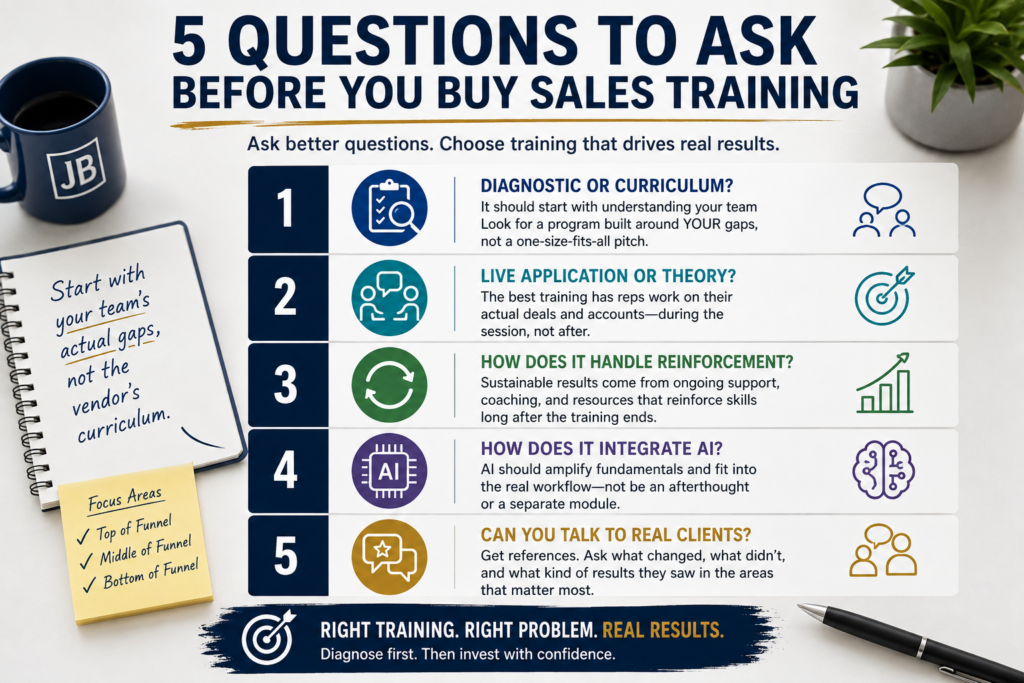
Five questions to ask before you buy
Once you know your gaps, use these questions to evaluate how to choose a sales training program that’s actually built for your situation.
1. Does it start with a diagnostic or a curriculum?
Any program worth buying should want to understand your team before prescribing a solution. If the vendor is pitching you the same program they pitch everyone else, that’s a signal. Good training is built around your specific gaps, your sales motion, your buyer, and your market. If those aren’t part of the conversation before the proposal, move on.
2. Does it teach through live application or through theory and role play?
There’s a significant difference between training where reps practice on hypothetical scenarios and training where reps work on their actual deals, accounts, and pipeline during the session itself. Live application means reps walk out having already done the work. Theory means they walk out with information and have to figure out how to apply it later. Most don’t.
3. How does it handle reinforcement?
A one-time training event is better than nothing. It’s also far less effective than a program with built-in reinforcement. How does the vendor support reps after the initial engagement? Is there ongoing coaching, a library of material to reference, live sessions to keep skills sharp? Training that doesn’t include a reinforcement plan assumes reps will maintain new habits on their own. They won’t.
4. How does it integrate AI?
If the program was built before 2023 and hasn’t been updated, it’s probably not accounting for how AI has changed the workflow for most reps. Reps are using AI for research, outreach drafting, and meeting prep. The training should show them how to use these tools to amplify fundamentals, not replace them. A program that treats AI as a separate topic rather than an integrated part of the workflow is already behind.
5. Can you talk to teams who have been through it?
References matter. Not the testimonials on the vendor’s site. Real conversations with sales leaders who have put their teams through the program and can tell you what changed and what didn’t. Ask them specifically about results in the areas where your team is struggling, not results in general.
What to watch out for
A few things worth naming directly.
Brand recognition is not a proxy for fit. Some of the most recognizable training brands deliver standardized programs that work for some teams and miss badly for others. A known name means the vendor has been around long enough to market well. It doesn’t mean the program is right for your team.
Certification and training are not the same thing. Getting your team certified in a sales methodology creates a common language. That’s valuable. It’s not the same as improving execution. If your reps can’t run real discovery calls, a MEDDICC certification doesn’t fix that. If your pipeline generation is broken, Challenger certification doesn’t fix that. Methodology adoption and skills development address different problems.
The lowest-cost option is rarely the lowest-risk option. Bad training doesn’t just waste money. It consumes the time and attention of your entire team, often creates cynicism about training in general, and delays fixing the actual problem by six to twelve months. The cost of a failed training engagement is the cost of the program plus the cost of another quarter with the same gaps.
How JB Sales approaches this decision
I’ve spent 25+ years working inside sales organizations at Salesforce, LinkedIn, Google, Amazon, and Okta. Not advising from the outside. I’ve seen what makes training work and what makes it fail. The pattern is consistent.
Training works when it’s matched to the team’s actual gaps, delivered through live application on real deals, and reinforced over time. Training fails when it’s generic, theoretical, and one-time.
My training is built around two core programs, Filling the Funnel for top-of-funnel work and Driving to Close for pipeline management and closing, delivered through an agile framework I customize to each client. Before every engagement, I diagnose where the team’s gaps are and build the program around that. The training uses live exercises on real accounts and pipeline, not made-up scenarios. Both programs now include AI application layers so reps learn the fundamentals and the tools together, in the right order.
For leaders who are still working out whether their team needs a process overhaul or better execution of the one they have, JB Sales Advisory is a 3-month strategic engagement that starts with a written diagnostic of your sales motion, AI readiness, and team structure before recommending a path.
How JB Sales compares to specific alternatives
If you’re evaluating JB Sales alongside specific programs or frameworks, here are honest breakdowns of both:
- JB Sales vs. Sandler: how a standardized methodology compares to an agile framework, and which teams each is right for
- JB Sales vs. MEDDICC: why qualification frameworks and sales training aren’t competing products, and how they work together
Frequently asked questions
How do I know if my sales team needs training or a new sales process?
Start with a diagnostic of your team’s actual gaps. If your fundamentals are sound but execution is inconsistent, that’s a training problem. If the process itself is broken, training alone won’t fix it. The replace, rebuild, or retrain framework is a useful starting point before you evaluate vendors.
What makes a sales training program effective?
The most effective programs start with a diagnostic of the team’s specific gaps, deliver training through live application on real deals rather than hypothetical role play, and include a reinforcement plan after the initial engagement. One-time training events without reinforcement produce short-term behavior change at best.
How long does sales training take to show results?
Meaningful improvement in the leading indicators, discovery call quality, pipeline accuracy, and conversion rates by stage, is typically visible within one quarter when training is matched to the right gaps and followed with reinforcement. Full impact on win rate and deal size tends to be visible within two quarters.
Is sales methodology certification the same as sales training?
No. Methodology certification creates a common language and qualification framework. That’s valuable, but it doesn’t improve execution. A rep who is MEDDICC-certified but can’t run a real discovery call still can’t run a real discovery call. Certification and skills development address different problems and both have a place in the right sequence.
How do you evaluate sales training ROI?
Track outcome metrics, not activity metrics. Win rate, average deal size, pipeline quality, and time to close are the numbers that tell you whether training is working. Activity metrics like meetings booked or emails sent can move without any improvement in results. Set a baseline before the engagement starts and measure the same metrics at 30, 60, and 90 days after.
John Barrows helps sales leaders decide whether to replace, rebuild, or retrain their teams for the AI era. For 25+ years he has worked with the world’s most demanding sales organizations, including Salesforce, LinkedIn, Google, Amazon, and Okta, building the frameworks that became Filling the Funnel and Driving to Close. Today he advises CROs and VPs of Sales on AI readiness, team restructuring, and go-to-market strategy, drawing on exposure to every type of B2B sales organization over that span. John believes sales is a science, not a personality contest. His training focuses on the fundamentals that hold up regardless of what the market or the technology does next. He has been featured in Forbes, Harvard Business Review, Inc., Fortune, Entrepreneur, and the Boston Business Journal. He is the host of Make It Happen Mondays, author of I Want to Be in Sales When I Grow Up, and an LP at GTMfund.


