By John Barrows | August 2026
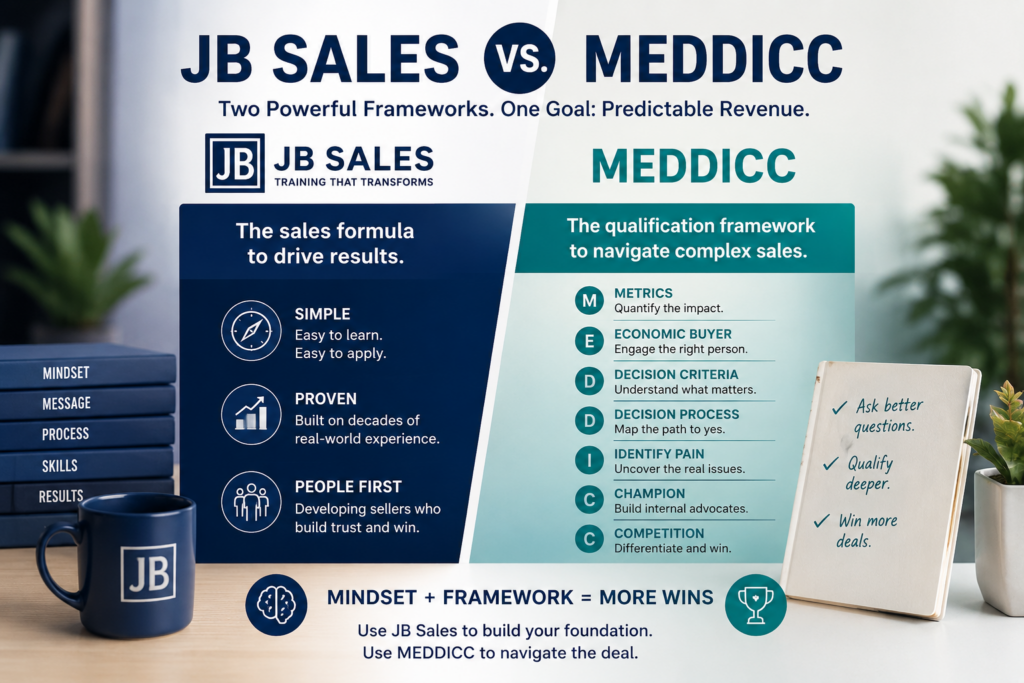
If you are evaluating JB Sales vs MEDDICC, here is the short version. MEDDICC is a qualification framework. It tells your reps what information they need to have about a deal to know whether it is real and whether you can win it. JB Sales is a skills training program. It teaches your reps how to have the conversations that uncover that information. One tells you what to find out. The other teaches you how to find it out. They solve different layers of the same problem, and the leaders I see get the most out of both understand the difference.
There is a second difference that matters even more, and I will get into it below. MEDDICC only tracks what you are trying to GET from the client. It says nothing about what the client is asking of you or what you are GIVING away to keep the deal alive. That makes it a picture of the selling process, not the buying process. The JB Sales Deal Scorecard, which is the deal management layer inside the Driving to Close program, tracks the gives and the gets together, which is what gives you an objective view of the whole deal.
Force Management is the most well-known company that trains MEDDICC, specifically their version called MEDDPICC. If you are comparing Force Management to JB Sales, you are comparing a $100,000 to $500,000 enterprise change management initiative designed for organizations with complex, multi-stakeholder deals to a skills training program that works at that level and below it. They are not the same investment and they are not solving the same problem.
Here is how to figure out which one your team actually needs.
What MEDDICC is and what problem it actually solves
MEDDICC was created at Parametric Technology Corporation in 1996 by Dick Dunkel, working under John McMahon and alongside Jack Napoli. PTC used it to grow their sales organization from $300 million to $1 billion in four years. The framework gives salespeople a structured way to qualify complex deals by capturing six things about every opportunity: the Metrics that quantify the business impact, the Economic Buyer who controls the budget, the Decision Criteria the company is using to evaluate vendors, the Decision Process that determines how they will actually make the choice, the Pain that is driving the urgency, and the Champion inside the account who will sell it internally. The two additions in MEDDICC add Competition and an additional C for Confirmed Pain or, in MEDDPICC, Paper Process.
What MEDDICC solves is a qualification and pipeline accuracy problem. It is the answer to the question: how do we know which deals are real and which ones are going to die quietly in stage four? It forces reps to prove they understand the deal before it advances. If a rep cannot fill in the Economic Buyer, the deal does not move. If the decision process is not mapped, the deal does not move. This is why MEDDICC became the standard qualification framework in enterprise SaaS. It is predictive. Teams that implement it well have cleaner pipelines, fewer late-stage surprises, and better forecast accuracy.
What MEDDICC does not solve is a skills problem. MEDDICC tells your rep to identify the Economic Buyer. It does not teach them how to get access to that person when the initial contact is three levels below. MEDDICC tells your rep to quantify the Metrics. It does not teach them how to run the discovery conversation that uncovers what those metrics actually are. The framework defines the outcome. The skills training defines how to get there.
What MEDDICC misses: every deal has gives, and MEDDICC only tracks the gets
Let me be clear about where I stand on MEDDICC, because this is the part of the comparison that gets skipped. MEDDICC is a really good qualification framework. Every component in it is worth identifying, tracking, and coaching to on every deal that matters. I am not in the camp that wants to tear it down.
My issue is what it leaves out. Look at the components again. Metrics, Economic Buyer, Decision Criteria, Decision Process, Pain, Champion. Every single one of them is something we are trying to get from the client. Information we need to extract, access we need to earn, an advocate we need to recruit. Nowhere in the framework is there a line for what the client is asking of us, or what we are giving away to keep the deal moving. The demo environments, the custom pricing, the security reviews, the reference calls, the executive time, the free pilots. All of that is invisible to MEDDICC.
That matters because a deal is a two-way exchange. There is a selling process and there is a buying process, and MEDDICC only shows you the selling side. A rep can have every MEDDICC field filled in perfectly and still be running a lopsided deal where they hand over everything the buyer asks for without getting a single commitment in return. The framework will tell you that deal is qualified. It will not tell you the buyer is using your rep for free consulting and a column-fodder quote.
This is why I built the JB Sales Deal Scorecard, which is the deal management layer inside the Driving to Close program. The scorecard outlines both the gives and the gets. The gets side is essentially MEDDICC expanded. The gives side tracks everything flowing the other direction. When you marry the two up, you get an objective view of the deal instead of the rep’s optimistic narrative. Is the exchange balanced? Are we trading value for commitments, or donating resources and hoping? That is the question the scorecard answers and MEDDICC cannot.
The way I position the two with the teams I train: the scorecard is the front end and MEDDICC is the back end. The scorecard gives you the simple, objective, at-a-glance view of the deal that a rep can actually use in the room and a manager can actually coach to in a pipeline review. Behind it sits the detailed MEDDICC-style information, which is critical to keep track of. The details are not the problem. The problem is treating the qualification checklist as the whole system instead of one side of an overall framework that shows the full picture of the buying and selling process.
What Force Management does
Force Management is a sales training consultancy founded in 2003 and based in Charlotte, North Carolina. They specialize in enterprise sales transformation for complex B2B organizations, primarily SaaS companies running $100,000-plus ACV deals with six-to-twelve month sales cycles and five or more stakeholders involved in the decision.
Their methodology runs on two connected programs. Command of the Message is their value messaging framework, which gives sales teams a structured way to articulate why a buyer should choose their solution over every alternative, including the alternative of doing nothing. Command of the Sale is their execution process, which defines how to advance deals through each stage. MEDDPICC sits on top of both as the qualification layer that tells reps what information they need and whether the deal deserves continued investment.
If you want the direct mapping to my programs, Command of the Message lines up with Filling the Funnel and Command of the Sale lines up with Driving to Close. The difference is in how they operate. Command of the Message hands the team a defined messaging structure to install. Filling the Funnel is a more agile framework: it gives reps a way to test and try different approaches, land on succinct messaging they can actually execute with, and align that messaging with the values of the organization and the personas they go after, then keep adapting it as the market shifts. On the execution side, Command of the Sale defines a standard process for advancing deals through stages. Driving to Close is the deal framework for customizing the approach, and the scorecard, to the specific deal and client in front of you, because no two deals move the same way.
Force Management is a serious enterprise investment. Their rollouts run $100,000 to $500,000 depending on team size and scope, and they are explicit that implementation takes 18 to 24 months with executive sponsorship as a hard requirement. Their success rate of 78 to 85 percent, which they cite in their own materials, is tied directly to whether the organization treats the engagement as a change management initiative. This is not a training event. It is a multi-year transformation program.
For the right organization, that investment makes sense. For an enterprise SaaS company with a large sales org, complex deals, and a CRO who is committed to building the systems and culture around the methodology, Force Management is a strong choice. For most sales organizations, it is more than what they need and more than what they can execute.
Where MEDDICC breaks down without the skills to back it up
Here is the failure mode I see most often. A company implements MEDDICC, trains the team on the framework, builds it into Salesforce, and makes it a requirement for every deal to advance. Six months later, reps are filling in the MEDDICC fields but the deal quality has not improved. Win rate is the same. Late-stage losses are still happening.
The problem is that MEDDICC is a checklist, not a skill. Filling in the “Identify Pain” field does not mean a rep understands the buyer’s real pain. It means they typed something into the field. If the rep does not know how to run a discovery conversation that gets past the surface, they will write down whatever the buyer said in the first meeting and call it pain. The qualification framework is only as good as the underlying skill of the person using it.
I have worked with companies that ran Force Management before coming to JB Sales, and the pattern is consistent. The executives loved MEDDPICC because it gave them visibility into the pipeline. The reps found it burdensome because they felt like they were filling out paperwork. And the numbers did not move because the framework told reps what to know but did not teach them how to have the conversations that produce that knowledge. AI has since taken most of that paperwork burden away, which I get into below. The skills gap it exposed is still the point.
The fix is not abandoning MEDDICC. The fix is pairing the framework with the discovery and qualification skills training that makes the framework actually work, and putting it inside a deal view that tracks both sides of the exchange. That is where Driving to Close comes in.
What JB Sales does differently
JB Sales is a skills training program built around two core frameworks: Filling the Funnel, which covers prospecting and top-of-funnel execution, and Driving to Close, which covers the full sales cycle from discovery through negotiation and close.
Driving to Close is where the MEDDICC comparison is most relevant. The program teaches reps how to run a discovery call that actually gets to the real pain, not the stated problem. It teaches how to map the decision process by asking the right questions at the right time, not by waiting until the proposal goes out and realizing nobody asked. It teaches how to build a champion and how to get access to the Economic Buyer when the initial relationship is with someone three levels below.
Driving to Close also gives reps and managers the Deal Scorecard, the gives-and-gets view I described above. Reps learn to track what they are giving and what they are getting on every material deal, trade value for commitments instead of giving things away for free, and read the balance of the deal objectively. Managers use the same scorecard to run deal reviews that take minutes instead of meetings, with the MEDDICC-level detail sitting behind it for the deals that need a deeper look.
In other words, Driving to Close teaches the skills that make MEDDICC work and supplies the overall framework MEDDICC should live inside. The framework tells you what to capture. The program teaches you how to capture it and what to do with it once you have it.
JB Sales works with organizations from growth-stage to enterprise across Salesforce, LinkedIn, Google, Amazon, and hundreds of other B2B companies over 25-plus years. Team training programs start at $7,500 for smaller teams and go up to $25,000 to $50,000 for dedicated rollouts. The advisory engagement for VP-level leaders starts at $35,000 for a three-month engagement. The individual training programs, JB Sales Elite and JB Sales Pro, give individual sellers access to the full framework without a team-level commitment.
JB Sales vs. Force Management: the key differences
| JB Sales | Force Management | |
|---|---|---|
| What it is | Skills training program covering full sales cycle | Enterprise sales transformation consultancy |
| Framework | Filling the Funnel + Driving to Close (includes Deal Scorecard) | MEDDPICC + Command of the Message + Command of the Sale |
| Deal view | Gives and gets tracked together (buying + selling process) | Qualification criteria (what to get from the deal) |
| Primary focus | Execution skills: discovery, qualification, negotiation, close | Pipeline qualification + value messaging for complex enterprise deals |
| Best for | Growth-stage to enterprise; teams that need execution skills | Enterprise SaaS with $100K+ ACV, 90+ day cycles, 5+ stakeholders |
| Investment | $7,500 to $50,000 for team programs; $35,000 for advisory | $100,000 to $500,000; 18-24 month change initiative |
| Time to value | Skills apply immediately; first results in 30-90 days | 18-24 months to full implementation |
| AI integration | Built in; both programs updated with AI application layer | Not a primary focus |
| What it does not do | Does not give you a CRM-native qualification framework out of the box | Does not teach the underlying discovery and conversation skills independently |
Who Force Management is right for
Force Management is the right investment for enterprise sales organizations with complex, multi-stakeholder deals and the resources and executive commitment to run an 18 to 24 month transformation program. Specifically, if your deals regularly involve five or more stakeholders, run for 90 or more days, and average $100,000 or more in ACV, MEDDPICC is a serious tool for your pipeline. If you have a CRO or Chief Sales Officer who is committed to making methodology adoption a cultural initiative, not a training event, Force Management can deliver real results.
It is not the right investment if you need to see improvement in the next quarter. It is not the right investment if your team has gaps in basic discovery and qualification skills, because MEDDPICC will not fix those gaps on its own. And it is not the right investment for organizations where the primary problem is rep execution rather than pipeline visibility.
Who JB Sales is right for
JB Sales is the right investment when the gap is in execution skills. If your reps know what they are supposed to do but cannot do it consistently in a live conversation, that is a skills problem. If your win rate is low because reps are not getting to real pain, not mapping the decision process, not building champions, and not handling objections with any depth, that is a skills problem. If your team already uses MEDDICC but the data going into the framework is thin and optimistic, that is a skills problem. And if your deal reviews are subjective storytelling sessions because nobody is tracking what you are giving against what you are getting, that is a deal management problem the scorecard was built for.
JB Sales also fits organizations that need an advisory layer alongside training. The JB Sales Advisory engagement works with VP-level leaders to diagnose what is actually broken in their sales motion before recommending what to fix. For a leader who is being pressured to improve numbers without a clear picture of where the breakdown is, that diagnostic step matters.
JB Sales works across company sizes, from teams of ten to organizations of hundreds, and across ACV ranges that would not meet Force Management’s criteria. The training is fully applicable at the enterprise level, and where it is especially valuable is with smaller and growing companies that have not figured out their exact sales process yet, because the frameworks give them the structure to figure it out. Instead of installing a rigid enterprise methodology before you know what your sales motion even is, you get an agile framework you can shape around your buyers as you learn. The fundamentals of discovery, qualification, and deal management are the same regardless of deal size. What changes is the complexity of application, and Driving to Close covers that range.
The economics reflect that same reality. JB Sales runs a fraction of a Force Management engagement, implements in weeks instead of 18 to 24 months, and shows ROI in the first quarter rather than after a multi-year transformation. For a growing company, that difference is not a nice-to-have. It is the difference between an investment you can make now and one you have to defer until you are big enough to absorb it.
Can you use both?
Yes, and many of the best sales organizations do. This is exactly how I position it. MEDDICC handles pipeline qualification and forecast accuracy. JB Sales handles the skills that make the people using MEDDICC effective, plus the gives-and-gets scorecard that puts the MEDDICC detail into an objective view of the whole deal. They are not in competition with each other at the level of what they do. Where they compete is at the level of budget and attention. Most organizations do not have the resources to run a Force Management engagement and a JB Sales program simultaneously, and trying to run two major methodology initiatives at the same time usually means neither one sticks.
The sequencing that works: build the skills first. Teach your reps how to run discovery, how to qualify, how to map a decision process through actual conversation. Then layer in the framework on top of people who have the skills to use it well, with the scorecard as the front end and the MEDDICC detail as the back end. A rep who knows how to run a discovery conversation can use MEDDICC to capture and organize what they already know how to find out. A rep who does not know how to run a discovery conversation will use MEDDICC to document their guesses. And a manager who coaches to the scorecard is coaching the balance of the deal, not auditing a checklist.
How AI changes this comparison
MEDDICC is a data capture framework, and its biggest historical complaint was the administrative burden. Reps hated tracking the fields and updating the CRM, and managers spent deal reviews auditing data entry instead of coaching. AI has largely solved that problem. Tools like Gong, Chorus, and Clari can now record the conversation, extract the MEDDICC information, auto-populate the fields, surface missing information in real time, and flag deals where the Economic Buyer has not been identified.
If your company runs MEDDICC, this is one of the first things to get right: make sure your AI tools are scraping that information from calls and updating the CRM automatically, so the burden comes off your reps entirely. A rep whose MEDDICC fields fill themselves has no excuse for a thin deal record, and a manager gets clean pipeline data without policing anyone. For organizations already committed to MEDDICC, AI makes the framework more useful and dramatically less burdensome.
What AI cannot do is teach a rep how to have a better discovery conversation. A rep who gets AI-generated MEDDICC summaries of their calls is getting faster feedback on a shallow conversation. The quality of the output is limited by the quality of the input. If the rep is not asking good questions, the AI is summarizing a call where the rep did not get to real pain. That is not a MEDDICC problem. It is a skills problem.
Both JB Sales programs, Filling the Funnel and Driving to Close, have been updated with AI application layers so reps learn the core framework and the tools together, in the right order. The fundamentals come first. AI comes in to help reps execute those fundamentals faster, at scale, and with better consistency.
Frequently asked questions
What is the difference between JB Sales vs MEDDICC?
MEDDICC is a qualification framework that tells salespeople what information they need to have about a deal to determine whether it is winnable. JB Sales is a skills training program that teaches salespeople how to have the conversations that uncover that information, and it adds the Deal Scorecard, which tracks what you are giving in a deal alongside what you are getting. MEDDICC defines the outcome. JB Sales teaches how to get there and how to see the whole deal, not only the selling side. Many organizations use both.
What is the JB Sales Deal Scorecard and how does it relate to MEDDICC?
The Deal Scorecard is the deal management tool inside Driving to Close. It tracks the gets, which are essentially MEDDICC expanded, alongside the gives, which are everything the buyer is asking of you: demos, pricing, references, security reviews, executive time. Marrying the two creates an objective view of whether the deal is a balanced exchange or a one-way street. In practice the scorecard works as the simple front end of the deal view, and the detailed MEDDICC components sit behind it as the back end that reps track and managers coach to.
Is MEDDICC the same as Force Management?
No, but Force Management is the most well-known training provider built around MEDDICC, specifically their extended version called MEDDPICC. Force Management also teaches Command of the Message (value positioning) and Command of the Sale (deal execution). MEDDICC the framework can be implemented without Force Management, and several other providers and internal enablement teams teach variations of it.
Who should use Force Management?
Force Management is built for enterprise B2B sales organizations with high-ACV, complex, multi-stakeholder deals, typically $100,000 or more in ACV with 90-plus day cycles. Their rollouts run $100,000 to $500,000 and take 18 to 24 months to fully implement. They require executive sponsorship and work best as a company-wide change initiative rather than a training event. For organizations that fit that profile and have the commitment to see it through, Force Management delivers results.
Can MEDDICC and JB Sales work together?
Yes. MEDDICC and JB Sales solve different layers of the sales performance problem. MEDDICC gives organizations pipeline visibility and deal qualification discipline. JB Sales gives reps the discovery, qualification, and deal management skills that make MEDDICC meaningful, and the Deal Scorecard gives the MEDDICC detail a home inside an objective gives-and-gets view of the deal. The most common sequencing is to build the skills first through JB Sales training, then layer in MEDDICC as the qualification back end once reps have the underlying conversation skills to fill it in accurately.
What does JB Sales offer that MEDDICC does not?
JB Sales teaches the execution skills that make qualification frameworks like MEDDICC work: how to run a discovery call that gets to real pain, how to map a decision process through actual conversation, how to build a champion and get access to the economic buyer, how to handle objections with context rather than scripted rebuttals, and how to negotiate without giving up margin. It also adds what MEDDICC structurally leaves out: the Deal Scorecard tracks the gives alongside the gets, so leaders can see the buying process and the selling process in one view. And it includes an advisory engagement for VP-level leaders who need a diagnostic of what is actually broken before they invest in training.
Can AI fill in MEDDICC fields automatically?
Yes. Tools like Gong, Chorus, and Clari can record sales conversations, extract the MEDDICC information, and update the CRM fields automatically. This solves the administrative burden that made reps resist MEDDICC for years. If your organization runs MEDDICC, making sure your AI stack is doing this extraction and CRM updating is one of the highest-leverage moves available, because it takes the data entry off your reps completely. What AI cannot do is improve the quality of the conversation it is summarizing. That still comes down to the rep’s discovery skills.
Is MEDDICC worth it for smaller sales teams?
MEDDICC is a framework any team can adopt, regardless of size. The complexity of application scales with deal complexity. For smaller teams running simpler deals, a full MEDDPICC implementation may be more overhead than the deal cycle warrants. The core disciplines behind MEDDICC, qualifying opportunities rigorously, mapping the decision process early, and building internal champions, are worth building into any team’s process. The question is whether you need the full framework or whether cleaner discovery habits plus a simple gives-and-gets scorecard get you to the same result with less overhead.
Should I replace or rebuild my sales team before investing in MEDDICC or JB Sales?
Before investing in either, diagnose the actual problem. If one or two reps are underperforming, you may have a talent problem. If the whole team is underperforming, it is almost always a system problem: the discovery process is broken, qualification is too loose, or reps are not building the relationships inside accounts that drive deals to close. A system problem is a training problem, and training on execution skills is usually the right starting point. MEDDICC and Force Management address pipeline visibility. JB Sales addresses the execution skills and the deal management view that drive the underlying deal quality. See the full replace, rebuild, or retrain framework at learn.jbarrows.com/pages/replace-or-rebuild.
Make the right call for your team
For sales leaders evaluating their options: JB Sales Advisory is a 3-month strategic engagement that starts with a written diagnostic of your sales motion, including where win rate is breaking down and whether the gap is in skills, systems, or team composition, and ends with a 90-day plan you can execute. learn.jbarrows.com/pages/advisory
For teams that need execution skills: Driving to Close is a structured team training program built around the discovery, qualification, and deal management fundamentals that drive win rate, including the gives-and-gets Deal Scorecard. It includes an AI application layer so reps learn the core framework and the tools together, in the right order. learn.jbarrows.com/pages/team-packages
For individual sellers: JB Sales Elite is a 3-month engagement with weekly 1:1 coaching, a custom sales plan, and direct access to me. JB Sales Pro provides on-demand access to the full training library, live sessions, and group coaching. learn.jbarrows.com/pages/individual-packages
Compare the full sales training landscape at blog.jbarrows.com/blog/jb-sales-vs-sandler/. Fix the win rate problem first at blog.jbarrows.com/blog/improve-sales-win-rate/. See the full replace, rebuild, or retrain framework at learn.jbarrows.com/pages/replace-or-rebuild.
Figure out how to choose a sales training program at blog.jbarrows.com/blog/how-to-choose-a-sales-training-program.
John Barrows helps sales leaders decide whether to replace or rebuild their teams for the AI era. For 25+ years he has worked with the world’s most demanding sales organizations, including Salesforce, LinkedIn, Google, Amazon, and Okta, building the frameworks that became Filling the Funnel and Driving to Close. He is the host of Make It Happen Mondays, author of I Want to Be in Sales When I Grow Up, and an LP at GTMfund. His training programs are available at learn.jbarrows.com.


