By John Barrows | October 2026
Effort in sales sets you apart not because it is exceptional but because it has become rare. The bar for what passes as prepared, professional, and customer-focused has dropped so far that doing the basics consistently is enough to stand out: research before a call, a real agenda, a personalized message. Avis built a company around that idea once. What happened to it is a useful story for anyone in sales today.
What Avis got right
For decades, Avis ran one of the most effective advertising campaigns in business history. Their slogan was simple: “We Try Harder.” It was a direct acknowledgment that Hertz held the number one position and Avis was number two. Instead of pretending otherwise, they leaned into it. Being number two meant they could not afford to coast. Being number two meant they had to earn every customer. The message was honest, and it worked because the company actually backed it up.
That campaign captured something real about how effort functions as a competitive advantage. When you are the market leader, you can survive on momentum. When you are not, you win on the details. Avis understood that the difference between keeping a customer and losing one was often small: a cleaner car, a faster pickup, a more efficient process. They built an entire brand identity around the idea that effort was a strategy, not a personality trait.
What happened to trying harder
Avis is now number three. The “We Try Harder” slogan is still technically in their mission statement, buried three pages deep on their corporate website. The practice is mostly gone.
I had been an Avis Preferred customer for years. I rented a Tahoe for a family vacation and scheduled it two weeks in advance. When I arrived on a Friday at 4 PM, the car was not there. What followed involved a driver navigating Boston rush-hour traffic on a summer Friday to retrieve the vehicle from another location. After a long wait, I ended up negotiating the solution to their own problem myself. One employee stepped up and handled it well. The company did not.
When the car finally arrived, I found dog hair in the back seat, food debris in the crevices, and stains on the dashboard. A $1,200 rental. I spent an hour cleaning it before the trip. At some point between building a brand around effort and that moment in the parking lot, Avis stopped trying harder. What is worse is that no one inside the company seemed to notice or care enough to fix it.
Why the bar is low in sales
What struck me about that experience was not the inconvenience. It was that my expectations had already adjusted down. I had stopped expecting much, so even small things stood out when they actually happened. A carpet cleaner who put booties on before walking into my house earned my business for years on the strength of that one gesture. A landscaper kept me as a client not because his work was the best but because he emailed when he was going to be late. That is all it took.
The same thing has happened in B2B sales. Most reps show up to calls without researching the company. Most send LinkedIn invitations with the default message. Most follow up with “just checking in” and nothing else. When the majority of reps are doing the minimum, buyers stop expecting more. Which means anyone willing to do a little more looks like they are doing a lot.
What effort in sales actually looks like
Trying harder in sales is not about working longer hours or sending more emails. It is about doing the things most reps skip because they take five extra minutes. Research the company before you call. Find something specific to reference. Have a real agenda for the meeting and send it the day before. Send a thank-you note after a call. Customize your outreach instead of blasting a template.
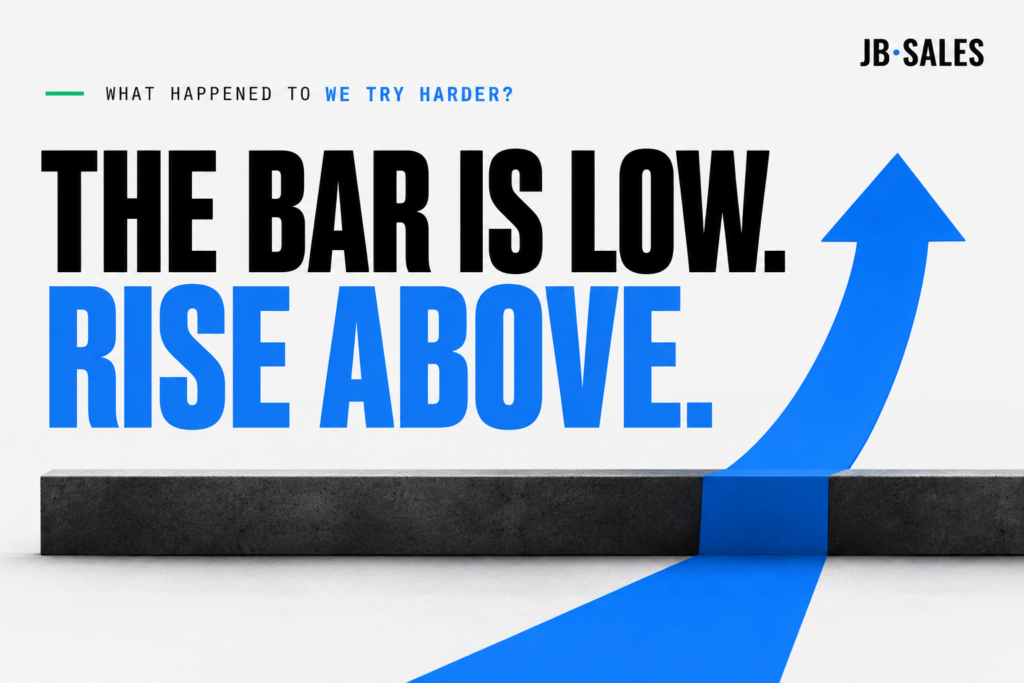
None of those things are heroic. They are basics. But when most reps are not doing them, doing them consistently makes you the rep who always shows up prepared, the one buyers actually look forward to hearing from. That is what the effort gap looks like from the buyer’s side. The bar is low. Rise above it.
Why consistency compounds
The reps I have seen build the best books of business are not always the most talented. They are the most consistent. They do not prepare sometimes. They always prepare. They do not send a thoughtful note occasionally. They do it after every meaningful conversation. Effort that happens once is a nice gesture. Effort that becomes your standard is how you build a reputation.
Buyers talk. They remember who made their lives easier. The rep who sends a clean meeting agenda and follows up with a real summary is the one they recommend when a colleague asks who to call. Effort in sales is cumulative. The small things you do on every call are not small over the course of a career. They are the whole thing.
Frequently asked questions
What does effort in sales actually mean?
Effort in sales means doing the specific, intentional things that most reps skip because they take extra time: researching an account before you call, customizing your outreach instead of blasting a template, sending a meeting agenda in advance, following up with a real summary instead of “just checking in.” It is not about working more hours. It is about using the time you have with more preparation and more precision than the reps around you.
Why has effort become a differentiator in B2B sales?
Because the average level of preparation and professionalism in B2B sales has dropped. Most reps are relying on volume: more dials, more emails, more activity. They are not investing in the quality of each interaction. That has lowered buyer expectations to the point where doing the basics consistently makes you stand out. When your competition is winging it, showing up prepared is a competitive advantage.
What small things make the biggest difference in sales?
The things that make the biggest difference are research before a call, a real agenda sent the day before a meeting, a personalized first line in outreach that references something specific about the prospect, and a follow-up that summarizes what was discussed and what happens next. None of these take more than a few minutes. All of them signal to the buyer that you treated their time as worth preparing for. That signal is rarer than it should be.
How do you build a reputation as a high-effort sales rep?
Consistency. The reps who build the best reputations are not the ones who occasionally do something impressive. They are the ones who show up prepared every time, follow up every time, and treat every interaction like it matters. Buyers remember the reps who made their lives easier. They recommend them to colleagues and return calls. Reputation in sales is built one prepared interaction at a time, and it accumulates faster than most reps realize once they make effort a standard rather than an exception.
What is the connection between the Avis “We Try Harder” slogan and sales?
The Avis campaign worked because it named something real: the company in the number two position cannot afford to coast, and if they lean into that reality instead of ignoring it, it becomes a genuine competitive advantage. Most sales reps are not the default choice in their prospect’s inbox. They are competing with every other rep fighting for the same attention. The Avis mindset is the right frame for anyone trying to break through in B2B sales: we are not the automatic choice, so we have to earn it every time. The bar is low. Rise above it.
The fundamentals that hold up
Filling the Funnel is built around the prospecting and outreach fundamentals that separate reps who build consistent pipeline from reps who chase activity metrics and wonder why nothing converts. See what teams are building at learn.jbarrows.com/pages/results.
John Barrows helps sales leaders decide whether to replace, rebuild, or retrain their teams for the AI era. For 25+ years he has worked with the world’s most demanding sales organizations, including Salesforce, LinkedIn, Google, Amazon, and Okta, building the frameworks that became Filling the Funnel and Driving to Close. Today he advises CROs and VPs of Sales on AI readiness, team restructuring, and go-to-market strategy, drawing on exposure to every type of B2B sales organization over that span. John believes sales is a science, not a personality contest. His training focuses on the fundamentals that hold up regardless of what the market or the technology does next. He has been featured in Forbes, Harvard Business Review, Inc., Fortune, Entrepreneur, and the Boston Business Journal. He is the host of Make It Happen Mondays, author of I Want to Be in Sales When I Grow Up, and an LP at GTMfund.


