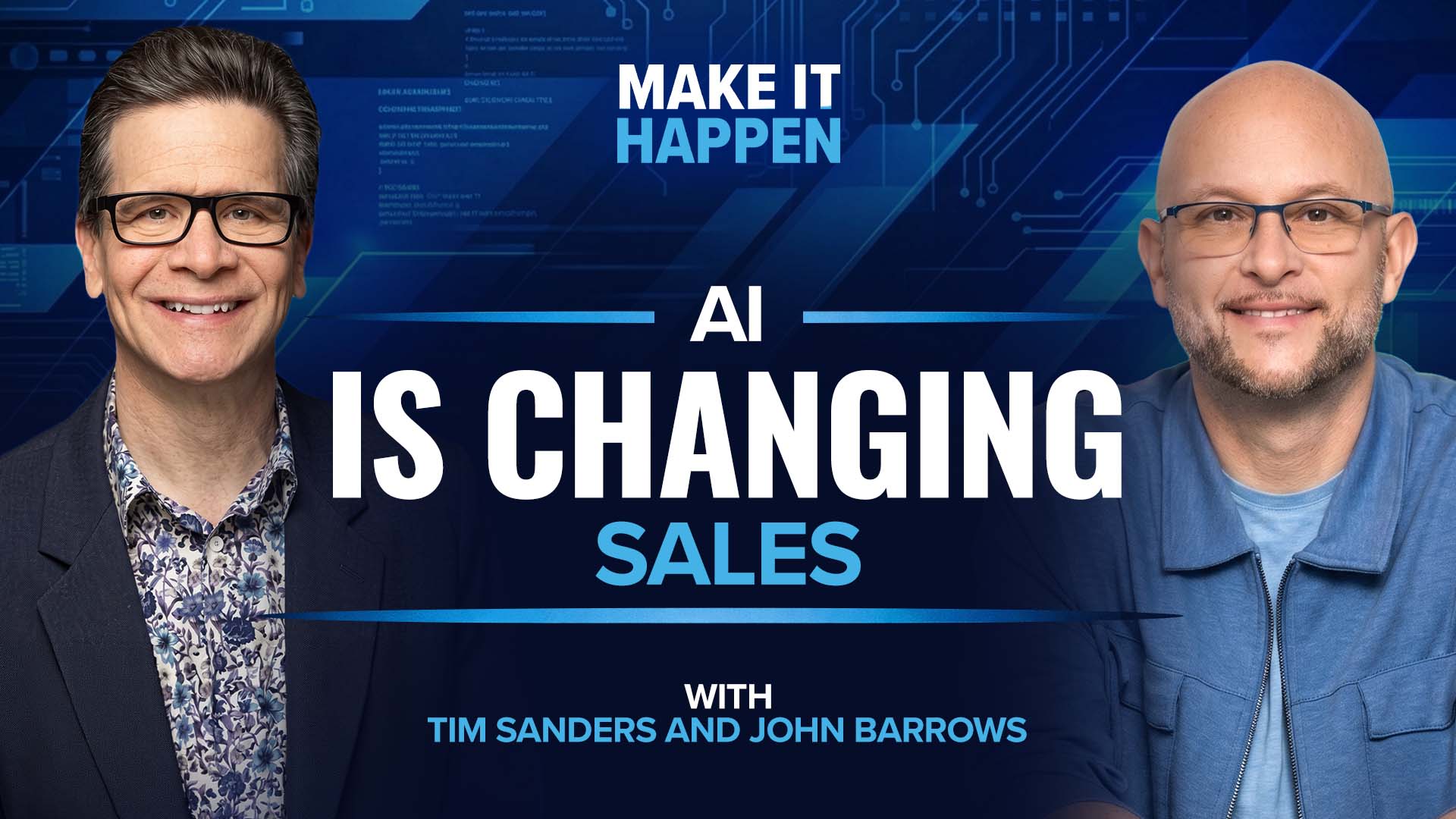
Half of all software buyers now start their AI buyer research inside ChatGPT or Gemini, and most of them are 80 percent through their purchase decision before a sales rep ever talks to them. In this episode, John Barrows sits down with Tim Sanders, Chief Innovation Officer at G2 and author of Love Is The Killer App, to talk about what that means for BDRs, why the best AEs today operate more like sommeliers than closers, and why domain expertise is the one thing AI still cannot replace in a sales conversation.
About Tim
Tim Sanders is Chief Innovation Officer at G2, where he researches how AI is reshaping B2B buying and helps G2’s customers adapt their go-to-market strategy. Before G2, he was Chief Innovation Officer at Upwork and spent years as an executive at Yahoo, following his early career with Mark Cuban’s broadcast.com. He is the author of five books, including Love Is The Killer App and Today We Are Rich.
Connect with Tim: timsanders.com | LinkedIn
What you’ll learn
- Why half of all software buyers now start their research inside ChatGPT or Gemini, and are 80 percent through their purchase before a sales rep ever talks to them
- Why the BDR, not the AE, has become the frontline of business intelligence for companies trying to win inside AI search
- Why Tim says today’s best AE is a sommelier, not a closer, and what that metaphor means for a buyer drowning in AI-generated options
- Why verifier’s law explains what AI still cannot be trusted to do in sales outreach, and why domain expertise is the one thing that makes a generalist model useful
Why half your buyers have already decided
The AI buyer research shift is not a future trend. It is already the default behavior for a significant portion of the B2B market. According to G2’s data, roughly half of all software buyers now open ChatGPT or Gemini before they ever visit a vendor’s website. They are asking the AI to build their shortlist, compare options, and explain tradeoffs. By the time they talk to a sales rep, the mental model is already formed. The rep’s job is not to introduce the category or explain why the solution matters. The buyer has done that work themselves. The rep has to meet them inside a decision that is already in progress.
This changes everything about how pipeline works. The top of the funnel is no longer a place where buyers are discovering options. It is a place where buyers are validating a shortlist that an AI engine helped them build. If your company is not showing up correctly in those AI-generated responses, with the right positioning, the right differentiation, and the right language, you are being filtered out before a human ever gets involved. The sales team does not get a chance to recover from that.
The BDR as frontline business intelligence
Tim’s argument is that BDRs are sitting on the most valuable data in the go-to-market organization, and most companies have no idea. Every time a BDR makes a call and a prospect pushes back, mentions a competitor, or describes their decision criteria, that is real-time market intelligence about how buyers are thinking and what language they are using. In the AI search era, that language is exactly what determines whether your company appears in the responses buyers are generating before the sales process even starts.
The companies that are going to win in AI search are the ones that feed that BDR intelligence back into their content, their positioning, and their presence on platforms like G2 where AI engines pull review data. The BDR is the closest person in the organization to the buyer’s actual language. Most go-to-market teams treat that role as a pipeline generator. Tim’s framing is that it is also the primary source of competitive and market intelligence the company needs to stay visible in AI-driven research.
The sommelier model for AEs
When a buyer has already done their AI buyer research and built a shortlist, the last thing they want from a sales rep is someone who is going to walk them back through the basics. That is the closer model, and it is increasingly irrelevant when the buyer arrives already knowing what the category does and roughly what the top options are.
Tim’s framing is that the best AEs today operate more like sommeliers. A sommelier does not try to convince you that wine is worth drinking. You already know that. What a sommelier does is help you navigate a crowded set of options using expertise you do not have, match the choice to your specific situation, and give you confidence that the decision is right. That is what the AI era buyer needs from a rep: someone who can take what the AI generated and make it specific, accurate, and meaningful to their actual situation. The rep who can do that adds value. The rep who walks in with a deck to explain the category is in trouble.
Why verifier’s law matters for sales
Tim introduced a concept he calls verifier’s law: AI is only as trustworthy as the domain expert who can check its output. A generalist AI model produces plausible responses. What it cannot do is guarantee those responses are accurate in a specific industry, for a specific use case, or in a specific competitive context. The human who can verify that output, who has enough domain expertise to catch when the AI is wrong, outdated, or missing important nuance, is the one who makes the AI useful.
In sales, this means the rep with deep domain expertise is not competing with AI. They are the quality control that makes AI-generated research trustworthy. A buyer who has used ChatGPT to build a shortlist still wants to talk to someone who actually knows the space, because the AI told them they should. The rep who walks in with genuine expertise in the buyer’s industry, use case, and competitive landscape is the one the buyer trusts to validate what the AI already told them. That expertise cannot be prompted into existence. It comes from the work.
What this means for how you build a sales team
If half your buyers are doing their AI buyer research before they ever talk to your team, the structure of the sales motion has to reflect that. BDRs need a feedback loop into marketing and content that did not exist before. AEs need to develop the domain expertise that earns credibility with a buyer who already knows the basics. And the entire go-to-market team needs to understand what language buyers are using when they ask AI engines about your category, because that language is now the front door to your pipeline.
The teams that figure this out early are going to look very different from the teams that are still running the same motion they used five years ago. The buyer has changed. The discovery process happens before the rep enters the conversation. The rep who understands that, and shows up prepared to add value inside a decision that is already in progress, is the one who is still relevant when everything else keeps changing.
Frequently asked questions
What is AI buyer research and how is it changing B2B sales?
AI buyer research is the process buyers use when they open ChatGPT, Gemini, or a similar AI engine to build a vendor shortlist, compare options, and understand a category before talking to any sales reps. G2 data suggests roughly half of software buyers now do this, and most of them are 80 percent through their decision before the first sales conversation. For B2B sales teams, this means the traditional top-of-funnel motion, where reps introduce the category and educate the buyer, is increasingly irrelevant. Buyers arrive already knowing what they want. The rep’s job is to validate and differentiate inside a decision that is already in progress.
Why are BDRs becoming business intelligence assets?
Every time a BDR calls a prospect and gets pushback, hears a competitor mentioned, or learns how a buyer is framing their decision criteria, that is real-time market intelligence. In the AI search era, the language buyers use when they describe their problem is exactly what determines whether your company shows up in the AI-generated research they do before contacting you. BDRs are the closest people in the go-to-market organization to that language. Teams that build feedback loops from BDR conversations back into content, positioning, and review platforms are the ones most likely to show up on the shortlists AI engines produce for their buyers.
What does the sommelier model mean for sales reps?
The sommelier model describes an AE who helps buyers navigate a crowded set of options using expertise the buyer does not have, rather than trying to convince them the category is worth buying into. When a buyer has already done AI-generated research and built a shortlist, they do not need a rep to walk them through the basics. They need someone who can take the AI’s output and make it specific, accurate, and relevant to their actual situation, matching the solution to their use case the way a sommelier matches a wine to a meal. The rep who can do that adds genuine value. The rep who shows up to explain the category is redundant.
What is verifier’s law and why does it matter in sales?
Verifier’s law is the principle that AI output is only as trustworthy as the domain expert who can check it. A generalist AI model produces plausible responses, but it cannot guarantee those responses are accurate in a specific industry, competitive context, or use case. The human with enough domain expertise to catch when the AI is wrong or incomplete is the one who makes the AI genuinely useful. In sales, this means reps with deep domain expertise are not being replaced by AI. They are becoming the quality control layer that makes AI-generated research trustworthy to the buyers who relied on it to build their shortlist.
How should sales teams adapt to AI-driven buyer research?
Three things matter most. First, BDRs need a feedback loop into content and marketing so that the language buyers use in real conversations shapes how the company shows up in AI-generated responses. Second, AEs need to develop genuine domain expertise in their buyers’ industries and use cases, because that expertise is what differentiates them from the AI-generated summary the buyer already has. Third, go-to-market leaders need to understand what buyers are typing when they ask AI engines about their category, because that is now the front door to the pipeline. Teams that align their content, positioning, and sales motion around these three priorities are the ones most likely to show up on the shortlists that AI engines produce.
John Barrows helps sales leaders decide whether to replace, rebuild, or retrain their teams for the AI era. For 25+ years he has worked with the world’s most demanding sales organizations, including Salesforce, LinkedIn, Google, Amazon, and Okta, building the frameworks that became Filling the Funnel and Driving to Close. Today he advises CROs and VPs of Sales on AI readiness, team restructuring, and go-to-market strategy, drawing on exposure to every type of B2B sales organization over that span. John believes sales is a science, not a personality contest. His training focuses on the fundamentals that hold up regardless of what the market or the technology does next. He has been featured in Forbes, Harvard Business Review, Inc., Fortune, Entrepreneur, and the Boston Business Journal. He is the host of Make It Happen Mondays, author of I Want to Be in Sales When I Grow Up, and an LP at GTMfund.
Get John’s weekly insights: subscribe to the JB Sales Learning Lab Newsletter.


